
The title says it all. ISP News posted an article today — “Want Broadband With Your Fries?” — describing Softbank’s move to put Wi-Fi into McDonald’s in Japan. Wi-Fi continues to move quickly as the hotspot technology of choice. Several US companies are doing the same thing, including Starbucks. One of the critical technologies that will have to emerge is universal identification between the providers. I’d hate to have to subscribe to three or five different Wi-Fi providers to get service. I see something similar to roaming service for cellular networks emerging for the Wi-Fi providers.
Apple’s Latest Moves
The Washington Post published an article on Apple yesterday discussing two new capabilities they are adding into their systems.
The first is iChat, an AOL Instant Messenger compatible client. This is reportedly the first time that AOL has allowed an external party to create a compatible IM client. Perhaps this will bode well for Jabber and others that have continually been reverse-engineering AIM because the folks at AOL haven’t been interested in other clients. No specifics on the quid pro quo, though — one has to wonder what AOL gets out of the deal. Perhaps they get bundled onto every shipped system for free.
The other capability is called Rendezvous. Rendezvous is a means of automatically connecting computers in a local area together for the purposes of sharing assets. For example two wireless-enabled computers in a room could easily discover each other and share music files without requiring a server to be present. A company called Calligo also does some of this. Rendezvous is based on the ZeroConf.
Apple has generally been more aggressive about technologies like these. They focus much effort on the user experience and try to provide simple, meaningful solutions. As a wireless user, for example, I find it sad that an arbitrary collection of Wi-Fi enabled computers can’t self-network — with DHCP servers or fixed IP addresses, connectivity isn’t possible. As someone who travels with Wi-Fi cards for my laptop and iPaq, I have never understood why those two devices can’t just figure out how to connect with each other when no access point is present and without requiring special configuration. Maybe Apple’s on to something …
Building The Killer Development Team
No apologies for the shameless self-promotion (isn’t that what weblogs are about anyway?) — Builder.COM, a CNet Networks web site, today published an article that I wrote entitled Building The Killer Development Team. It’s a discussion of how to create a software development group and what sorts of players to recruit. Enjoy —
Pen-Based Input
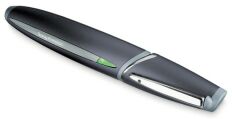 Anoto has created a device that allows text to be entered into a computer using a special pen. While this appears to have been done before in various forms (Mimeo and Crosspad, for example), the Anoto pen takes a slightly different approach. Instead of just recording the stokes that the pen takes, Anoto uses a special paper with a pattern of dots on it. This allows the system to know exactly where the pen is and to customize the input accordingly. So, for example, if checking the OK box on the page means that the content can be e-mailed, the system would be able to tell what the marking was and where it was on the page. The pen uses Bluetooth technology to transmit the information that the pen collects into similarly enabled devices — cell phones, PDAs, etc. The full details are on their “functionality” web site.
I have to say that this is one of the most compelling implementations of this technology that I’ve seen, but I remain skeptical about it’s usefulness. IBM produced a device called the Thinkpad TransNote, which was delivered with a writing tablet that captured pen strokes into an attached notebook computer (Business 2.0 — “Great Looking Product” sidebar When Good Designs Go Bad. The CrossPad also died — a system of paper and RF pen that transmitted text into a computer. Mimeo is a whiteboard system that stores the contents in a computer, but the form factor and clunky way of connecting to the computer has made that device all but useless.
So I think that Anoto is a longshot. The use of Bluetooth, a wireless technology for communicating over 10 meter distances, is a double-edged sword. On the plus side, wirelessly transmitting data from the pen into the computer or cell phone improves the odds of use, especially since the pen doesn’t look too large (at least from the pictures on their web site). But Bluetooth seems to me to be fading rapidly — 802.11/Wi-Fi has been all the rage and companies are applying it to all sorts of problems — including those problems that Bluetooth was intended to solve. Don’t misunderstand me on this — Wi-Fi was not designed to be the low power cable replacement technology like Bluetooth. It just turns out that the Wi-Fi folks are rapidly developing technology that will essentially replace Bluetooth, thus hindering Bluetooth’s adoption. So I don’t anticipate that a large number of devices will work with Anoto’s pen technology.
Frankly, I’m skeptical about the special paper too. Maybe certain environments, for example hospitals, where paper is normal will be a good target market for Anoto. But many business are rapidly moving to PDA and tablet technology that will likely overtake the market for pen and paper based solutions. I’d therefore expect Anoto get great hype because of its cool technology, but ultimately it will become a niche solution.