IP Discussed in E-Week

Let me start by saying that if you are not on IP, you probably should be. David Coursey, of ZiffDavis, published this article on Citizen Journalism, in particular referencing a post about NPR and Hurricane Katrina coverage. Since Mr. Coursey wrote his comments about this on the Internet, I thought I’d write my reply here (he was sent this via e-mail also). My comments below were sent to Dave Farber, the moderator of the IP list. You should probably click through on the link first and then read my remarks that follow:

Dave —

For me, the key statement in the article by Mr. Coursey is the following:

“What I have described isn’t a really big deal. While I can’t prove censorship didn’t take place*it’s always hard to completely rule out any possibility*it seems like what we have is a well-intended question that didn’t need to be so widely asked.”

Mr. Coursey seems to have difficulty with the concept of a large conversation space and is asserting that it is journalism. Really IP (and other lists) are discussion spaces, places where people hang out to ask questions, post ideas, and get comments. The fact that it’s moderated doesn’t make it journalism; we that subscribe all agree to allow you to decide what others might want to hear about. In this regard, we rely on you for this primarily because we assume you have some sense of what others are interested in and whether the participants on IP might want to discuss the topic. Or perhaps we just like the things that you pass along (are you the Rush Limbaugh of the listserv world?). Either way, we know what we are getting by subscribing; no one on this list is under any illusions that you provide a news service like Reuters or AP. Except, perhaps, for Mr. Coursey.

The wonder of the Internet is that we have the opportunity to have a conversation with a few thousand interesting people. Our choice to listen to certain channels is no different than our choices of what groups of people that we might listen to at a party; only on the Internet the room is bigger.

I will add one other comment, though, that Mr. Coursey should have brought up but didn’t. The reality of the Internet is that old cartoon about no one on the Internet knows that you are a dog. When someone does make a claim or comment about something, they are in many cases unknown individuals. In that regard, people are quicker to write things and pass them along than they would be if they had to say them in person. This leveling of the playing field sometimes brings out the worst in us — we’re too quick to judge, comment, and say things that perhaps we shouldn’t. That’s not a statement about editorial control, just about people and Internet. IP has fewer problems with this than most lists do — generally you don’t post things from people who are completely unknown to you and I can’t recall seeing a post without a name. But it is a reality of the forum that we use.

As such, before Mr. Coursey decided to attack “citizen journalism”, he should have asked himself this — if we (IP) were all in an auditorium with you at the podium, would this question about NPR and Katrina have been asked by an individual sitting in the audience? My answer, after re-reading the original post, is “yes”. And that test to me indicates the value of the question and the appropriateness of the post — well-intentioned and widely asked.

Photos from Seattle Washington

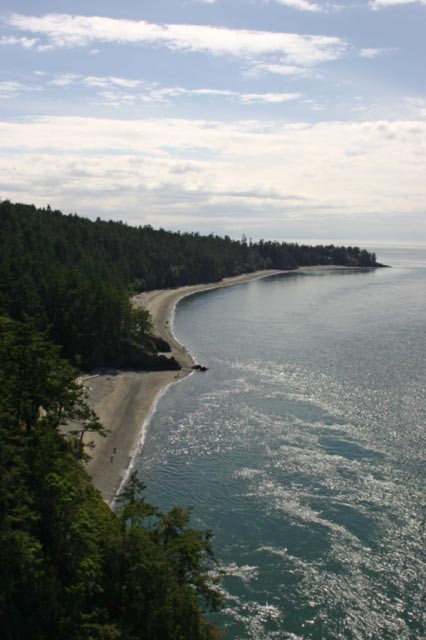
Most everyone who knows me knows that I am leaving the Washington DC area and moving to the great Northwest — Seattle Washington. I had the opportunity recently to take a motorcycle ride through Whidbey Island and discovered that Deception Pass is a spectacular sight.

Obviously I didn’t take this picture but I figured I should include a recent photo.
Deception_Pass1 (68k image)

This picture focuses in on the Deception Pass State Park. Minimal edits to the picture to lighten the trees. Shot from my Digital Rebel, 24mm focal length, 1/400 sec, f/10, iso 100. Really a spectacular photo.

Deception_Pass2 (62k image)

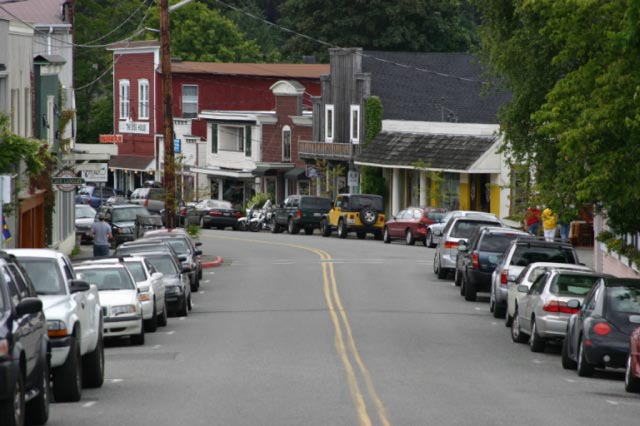
One more from the town of Langley. Langley is a tiny town on the coast of Whidbey Island. I’m not sure what compelled me, but I walked out into the middle of the street and took this picture. Shot from my Digital Rebel, 110mm focal length, 1/250 sec, f/5.6, iso 100.

Langley (70k image)

One more. Yes, it occasionally rains in Seattle. Afterwards, the rainbows look spectacular. Shot from my Digital Rebel, 24mm focal length, 1/125 sec, f/5.6, iso 100.

Rainbow-1-1 (35k image)

Generating Colliding X.509 Certificates

I just finished reading Colliding X.509 Certificates by Arjen Lenstra, Xiaoyun Wang, and Benne de Weger and I now have chills running up my spine. If I understand the paper correctly, the researchers generated two RSA moduli that could be swapped but still produce the same MD5, which means that the contents of a certificate signed by a trusted third party could be replaced using the same signature. The attack isn’t on the public key itself since the factors necessary to generate the private key are still computationally hard to obtain but rather on the content of the certificate. The key assumption is that the certificate is signed by a third party signer, which supplies the public key for verification.

Even as posed, this is a pretty scary paper. You could generate a certificate with your legitimate content in it (distinguished name, etc.), get that signed by a Trusted Third Party (TTP) and replace the key with another that wasn’t actually signed by the TTP. In essence this means that the TTP signature does not guarantee that the certificate holder actually has the private key to go along with the key that was originally signed. This also means that certificates signed using MD5 are not to be trusted.

The Next Step In Online Music

I’ve been thinking about a post that I made a few days ago that linked to an article discussing the economics of Napster-To-Go versus iTunes. The conclusions from this article focused on the losses of the music industry as a result of P2P sharing.

This morning I read this USAToday article which describes how many big players are giving away MP3 players, Blackberries, and PDAs in exchange for some purchase (e.g. buy a round-trip ticket on United and get a BlackBerry). Of course, the string here is that you have to subscribe to some service contract for some period of time, where they make up the money.

That brings me to what the next evolution in online music. Much like we get cell-phones for a very low price in exchange for a 2 year service agreement, the next step is that we will be able to get music players with the same sort of deal. It makes perfect sense to me as the music industry begins to embrace digital music subscriptions. And why not? Imagine getting an iPod for free in exchange for a 2 year, $30/month subscription to iTunes. That would be $720 paid over time, but you get all the music you can drink in that period. The music dies when the subscription dies, but since the service provider can keep it forever for me, why do I care? I can get the music whenever I want. With extension for multiple players (e.g. family plans) I end up with an unlimited, on-demand music library, which is probably my ideal.

So what’s wrong with the existing Napster model? To much money up front. I have to buy a music player for $300 to get to use it. If the music player is part of the subscription, then just like a cell phone, I’ll throw it away when my 2 year service agreement is up. After all, that’s sort of what’s happening with MP3 players anyway. I’ve had 2 disk-based units now (an Archos and an iPod) over the span of about 4 or so years. They break, they become old tech, I want a new one. What a perfect scheme. If Apple’s on the ball, that’s what will happen next, but I’m betting that Napster or some other service provider will jump on this first.